
How to Install a Backflow Preventer?

Installing a backflow preventer includes evaluating system requirements, selecting the appropriate device, and following a structured installation process to ensure proper flow direction, secure connections, and code compliance. The procedure includes checking the hazard level, pipe compatibility, water pressure, and installation location, followed by safe execution steps such as shutting off the water supply, cutting and preparing pipes, mounting the unit, and testing the system.
Different types of backflow preventers, such as air gaps, vacuum breakers, double-check valves, and reduced-pressure assemblies, require specific installation methods based on hazard levels and system needs. Proper maintenance, regular testing, and avoiding common installation mistakes ensure long-term performance, regulatory compliance, and reliable protection of the water supply. Understanding installation time, cost factors, and when to repair or replace a unit further supports a safe and efficient plumbing system.
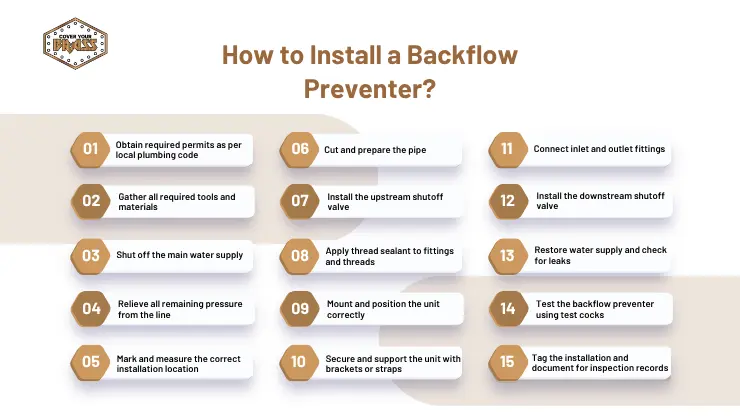
Step-by-Step Installation Overview:
Obtain required permits as per local plumbing code
Gather all required tools and materials
Shut off the main water supply
Relieve all remaining pressure from the line
Mark and measure the correct installation location
Cut and prepare the pipe
Install the upstream shutoff valve
Apply thread sealant to fittings and threads
Mount and position the unit correctly
Secure and support the unit with brackets or straps
Connect inlet and outlet fittings
Install the downstream shutoff valve
Restore water supply and check for leaks
Test the backflow preventer using test cocks
Tag the installation and document for inspection records
What Should You Consider Before Installing a Backflow Preventer?
Before installing a backflow preventer, consider hazard levels of water application, device types, pipe compatibility, system requirements, installation orientation, accessibility, and local codes. These factors ensure the unit integrates securely and protects the potable water supply. A correct evaluation ensures proper installation, prevents reverse water flow, and supports long-term system performance and compliance.
8 major things to consider before installing a backflow preventer are:
Hazard Level of Your Water Application: Identify the hazard level before you install the unit to prevent drinking water contamination through a double-check or reduced-pressure assembly.
Type of Backflow Preventer Required for Your System: Match the backflow preventer to the application to mitigate specific contamination risks for irrigation, fire lines, or boilers.
Pipe Size and Compatibility With Existing Plumbing: Check the pipe size, fitting type, and material before installation to ensure a secure connection and smooth flow with matching valves and fittings.
Potable vs Non-Potable Water System Requirements: Confirm whether the line carries potable water or non-potable water to ensure consumer safety by following the stricter installation requirements for drinking water lines.
Water Pressure and Flow Requirements: Verify the available pressure and expected flow rate to maintain system performance despite the pressure drop created by the prevention device.
Approved Installation Orientation (Horizontal or Vertical): Check the manufacturer's instructions and local plumbing codes to ensure proper mechanical operation in the required horizontal or vertical position.
Location and Accessibility for Future Testing and Maintenance: Choose an accessible backflow installation location to allow for mandatory certified testing, valve cleaning, and component replacement.
Local Plumbing Codes, Permits and Regulations: Review local plumbing codes, permit rules, and water authority requirements to achieve full code compliance through approved devices and annual testing.
What Are the Essential Safety Tips to Follow When Installing a Backflow Preventer?
Essential safety tips to follow when installing a backflow preventer include wearing safety glasses and gloves to prevent injuries from debris or spray and shutting off the main water supply to ensure a dry workspace. You must fully depressurize and drain lines before cutting to avoid sudden discharge. Inspect existing pipes for corrosion and install the unit in the correct flow direction as marked to ensure proper valve function. Use only certified, code-approved units and fittings to guarantee legal and material safety. Avoid overtightening fittings to prevent structural failure and never install units in submerged or unventilated spaces. Always test for leaks immediately after restoring the water supply to verify the system's integrity.
Follow these essential safety tips:
Wear Safety Glasses and Gloves Throughout Installation
Shut off the Main Water Supply Completely Before Starting
Fully Depressurize and Drain the Line Before Cutting
Inspect Existing Pipes for Corrosion or Damage Beforehand
Install the Unit in the Correct Flow Direction as Marked
Use Only Certified and Code-Approved Backflow Preventer Units
Use Approved Fittings and Materials per Local Plumbing Code
Do Not Overtighten Fittings
Never Install in a Submerged or Unventilated Confined Space
Test for Leaks Immediately After Restoring Water Supply.
What Tools and Materials Are Needed to Install a Backflow Preventer?
To install a backflow preventer, the required tools include pipe wrenches, tubing cutters or hacksaws, screwdrivers, Teflon tape applicators, pressure gauges, drills, levels, buckets, and safety gear to ensure accurate cutting, alignment, and secure connections. Also, have ready the necessary materials, including the correct backflow preventer unit, shutoff valves, pipe thread sealant, union fittings, compatible pipes, mounting brackets, and test cocks, for proper operation and complete installation of a backflow prevention system. Using the right combination of tools and materials ensures a secure installation, prevents leaks, and maintains system compliance.
Tools

To complete a backflow preventer installation successfully, you must use specific plumbing tools to cut pipes, tighten connections, and verify system pressure. Having the right equipment, such as wrenches, cutters, and gauges, ensures the installation is performed safely and meets professional standards. The tools required for installing a backflow preventer include the following:
Pipe Wrenches / Adjustable Wrenches
Tubing Cutter or Hacksaw
Screwdriver Set and Nut Driver
Teflon Tape Applicator
Pressure Gauge
Drill and Drill Bits
Level
Bucket and Towels
Safety glasses and gloves
Materials

Securing a compliant installation requires high-quality components that match your specific water system and hazard level. Using the correct preventer unit, shutoff valves, and durable sealants prevents leaks and ensures the assembly remains easy to service in the future. To ensure a secure and compliant installation, assemble the following materials:
Backflow Preventer Unit (Correct Type for Your Application)
Shutoff Valves (Upstream and Downstream)
Pipe Thread Sealant (Teflon Tape or Pipe Dope)
Union Fittings
Copper or PVC Fittings and Pipes
Mounting Brackets or Support Straps
Test Cocks and Covers
What is the Step By Step Process to Install a Backflow Preventer?
The step-by-step process to install a backflow preventer includes obtaining permits, preparing tools and materials, shutting off and depressurizing the water line, cutting and preparing pipes, installing shutoff valves, positioning and securing the unit, connecting fittings, restoring water supply, and completing testing and documentation. Each step ensures the backflow prevention device integrates correctly with the plumbing system, maintains proper flow direction, and protects the potable water supply from reverse water flow.
Following this structured process ensures code compliance, secure installation, accurate testing, and long-term reliability of the backflow preventer.
Step 1: Obtain Required Permits as Per Local Plumbing Code
Obtain the necessary permits by contacting your local water authority or plumbing department before beginning the backflow preventer installation. This step ensures your backflow preventer meets regional safety standards and plumbing codes.
Review Local Plumbing Codes: Research specific regulations to determine the required device type and installation standards for your system.
Submit Permit Applications: Apply for approval through the local authority to ensure your project is legally authorized before work starts.
Confirm Inspection Requirements: Determine whether your system requires a formal inspection during or after installation.
Verify Certification Standards: Confirm that both the backflow prevention device and the installer meet all required certification benchmarks.
Following these permit requirements ensures a legal installation, prevents costly project delays, and guarantees your system complies with all safety and regulatory standards.
Step 2: Gather All Required Tools and Materials
Before starting the backflow preventer installation, gather all required tools and materials to ensure a smooth workflow and avoid unnecessary delays. Preparing items such as pipe wrenches, cutters, sealants, and the correct backflow preventer unit allows for accurate pipe work and secure system assembly.
Collect Installation Tools: Gather wrenches, pipe cutters, drills, and measuring devices for precise pipe preparation and fitting.
Prepare Safety Equipment: Wear safety glasses and gloves to protect against debris and sudden water exposure.
Verify the Backflow Preventer Unit: Confirm the selected device matches your specific system type and required hazard level.
Organize Fittings and Valves: Arrange shutoff valves, union fittings, and compatible pipes for quick access during the installation.
Check Sealants and Accessories: Keep thread sealant, mounting brackets, and test cocks ready to ensure a leak-proof and stable setup.
Proper preparation ensures an efficient installation, reduces errors, and helps you complete the backflow preventer setup without interruptions.
Step 3: Shut Off the Main Water Supply
Close the main water supply by shutting the primary valve to stop all water flow before beginning the installation. This step prevents accidental water discharge and ensures you can safely handle the pipes and fittings.
Locate the Main Shutoff Valve: Identify the primary valve connected to your main water supply line or near the water meter.
Close the Valve Completely: Turn the valve firmly to the off position to halt all water entering the plumbing system.
Verify the Water Shutdown: Open a nearby faucet to confirm that the water flow has stopped entirely.
Secure the Work Area: Ensure the line remains empty of residual water throughout the installation process.
Properly shutting off the water supply creates a safe working environment, prevents flooding, and allows for an accurate backflow preventer setup.
Step 4: Relieve All Remaining Pressure from the Line
Relieve all trapped pressure from the plumbing line by opening faucets or drain valves immediately after closing the main supply. Releasing this stored water and air prevents sudden discharges, minimizes the risk of pipe movement, and creates a safe environment for cutting the line.
Open Nearby Faucets: Turn on faucets connected to the system to vent trapped water and internal pressure.
Drain the Line Completely: Allow all remaining water to exit the pipes to create a dry, manageable working area.
Use Drain Valves: Open any available system drain valves to accelerate pressure release.
Confirm Pressure Release: Check that all water flow has stopped entirely before you begin cutting or disconnecting any pipes.
Properly relieving system pressure ensures safe handling of the plumbing, prevents accidental water discharge, and enables accurate installation of the backflow preventer.
Step 5: Mark and Measure the Correct Installation Location
Identify the optimal installation point on the water supply line where the backflow preventer can function effectively and remain accessible for future testing. Precise mapping of this section guarantees a proper fit, maintains necessary spacing, and ensures the setup meets all regulatory requirements.
Select an Appropriate Location: Choose a section of pipe that provides adequate clearance, accessibility, and the correct installation orientation.
Measure Pipe Length Accurately: Measure the space required for the backflow preventer, shutoff valves, and fittings.
Mark Cutting Points Clearly: Use a marker to indicate exact cut locations on the pipe for precise installation.
Ensure Code Compliance: Verify that the selected location meets local plumbing codes and required elevation standards.
Accurate marking and measurement ensure proper alignment, reduce installation errors, and support efficient installation of the backflow prevention device.
Step 6: Cut and Prepare the Pipe at the Marked Location
Prepare the marked section of the water supply line by removing the measured pipe segment to create space for the backflow preventer. Meticulous pipe preparation guarantees clean connections, maintains correct alignment, and prevents leaks during the final assembly.
Cut the Pipe Accurately: Use a tubing cutter or a hacksaw to make clean, straight cuts at the marked points.
Remove Burrs and Debris: Smooth the pipe edges using a deburring tool, sandpaper, or a round file and remove any debris to prevent damage to fittings and ensure proper sealing.
Clean the Pipe Surface: Wipe the pipe ends to remove dirt, moisture, or residue before connecting components.
Check Fit and Alignment: Dry-fit the backflow preventer and fittings to confirm correct spacing and alignment before final installation.
Proper cutting and preparation ensure secure connections, reduce the risk of leaks, and support efficient installation of the backflow prevention device.
Step 7: Install the Upstream Shutoff Valve
Install the upstream shutoff valve before the backflow preventer on the water supply line to control water flow and allow isolation during testing, maintenance, or repairs. Proper installation ensures safe operation and easy system control.
Position the Valve Correctly: Place the shutoff valve on the inlet side of the backflow preventer.
Align With Pipe Direction: Ensure the valve aligns with the water supply flow direction.
Secure the Connection: Attach the valve using appropriate fittings and thread sealant to prevent leaks.
Check Valve Operation: Open and close the valve to confirm smooth operation before proceeding.
Proper installation of the upstream shutoff valve allows controlled water flow, supports maintenance activities, and ensures safe operation of the backflow prevention system.
Step 8: Apply Thread Sealant to All Fittings and Threads
Apply thread sealant to all fittings and threads using Teflon tape or pipe dope to create a leak-proof seal and maintain pressure integrity. This step ensures secure joints and prevents water leakage throughout the plumbing system.
Clean the Threads: Wipe away dirt, moisture, or debris from the threads to ensure the sealant adheres properly.
Apply Sealant Uniformly: Wrap Teflon tape or spread pipe dope evenly around the threads in the direction of tightening.
Coat Every Joint: Confirm that every threaded connection, including valves and fittings, receives a consistent layer of sealant.
Prevent Over-Application: Use only the necessary amount of sealant to avoid internal blockages within the pipe or valve.
Careful sealant application stops leaks before they start, maintains system pressure, and guarantees a reliable backflow preventer setup.
Step 9: Mount and Position the Unit in the Correct Orientation
Mount the backflow preventer in its specified orientation, following the flow direction and installation guidelines, to ensure proper valve function. Correct placement guarantees effective contamination prevention and long-term device performance.
Align with Flow Direction: Position the unit so the internal water flow matches the arrow marking on the body.
Set the Correct Orientation: Install the device horizontally or vertically as dictated by the manufacturer and local plumbing codes.
Maintain Required Elevation: Ensure devices such as PVBs or RPZs are set at the required height to support their specific mechanical functions.
Verify Future Accessibility: Place the unit where technicians can easily reach it for testing, inspections, and routine maintenance.
Strategic positioning ensures reliable operation, prevents reverse water flow, and keeps the system compliant with safety regulations.
Step 10: Secure and Support the Unit with Brackets or Straps
Anchor the backflow preventer using brackets or straps to stabilize the unit, which minimizes pipe stress and preserves alignment during high-pressure operation. This reinforcement prevents shifting and protects the integrity of your plumbing connections.
Install Mounting Supports: Fasten heavy-duty brackets or straps to hold the device firmly against the wall or floor.
Distribute System Weight: Ensure the unit’s weight rests on the supports rather than pulling on the pipe joints.
Maintain Level Alignment: Position the device to keep it perfectly aligned with the supply line to avoid mechanical strain.
Verify Total Stability: Shake the unit gently to confirm it remains immobile under sudden pressure changes or water hammer.
Strategic bracing prevents long-term pipe fatigue, maintains leak-free connections, and guarantees the structural reliability of the backflow prevention system.
Step 11: Connect the Inlet and Outlet Fittings Securely
Attach the inlet and outlet fittings to the water supply line using the appropriate connectors and sealant to create a stable, leak-free assembly. Establishing these secure points ensures consistent water flow and maintains the pressure integrity of the entire backflow prevention system.
Align the Port Connections: Match the device’s inlet and outlet ports with the corresponding pipe ends to ensure the water flows in the correct direction.
Tighten All Fittings: Use professional-grade tools, such as an adjustable wrench or channel locks, to secure each connection firmly without over-torquing or stripping the threads.
Apply Necessary Sealants: Coat all threaded joints with Teflon tape or pipe dope to prevent potential leaks and maintain system pressure.
Confirm Connection Stability: Verify that each fitting is seated securely and remains perfectly aligned before moving to the next phase.
Establishing secure connections facilitates smooth water flow, eliminates the risk of drips, and ensures the backflow preventer operates as intended.
Step 12: Install the Downstream Shutoff Valve
Install the downstream shutoff valve after the backflow preventer on the outlet side to control water flow and isolate the system during testing, maintenance, or repairs.
Position the Valve Correctly: Place the shutoff valve on the outlet side of the backflow preventer.
Align With Flow Direction: Ensure the valve follows the correct direction of water flow through the system.
Secure the Connection: Attach the valve using proper fittings and thread sealant to prevent leaks.
Verify Valve Operation: Open and close the valve to confirm smooth, reliable operation.
Proper installation of the downstream shutoff valve allows controlled operation, supports maintenance activities, and ensures effective performance of the backflow prevention system.
Step 13: Restore Water Supply and Check for Leaks
Restore the water supply by slowly opening the main shutoff valve, allowing the system to repressurize while you monitor every connection for leaks. This careful approach prevents sudden pressure surges and ensures all joints remain watertight and functional.
Reopen the Main Valve Slowly: Turn the supply valve in small increments to avoid damaging the system with a rapid pressure spike.
Inspect Every Connection: Examine all fittings, valves, and threaded joints for any signs of moisture or visible dripping.
Observe Pressure Stability: Monitor the assembly using a pressure gauge to confirm the system maintains a steady pressure without fluctuations.
Address Immediate Leaks: Tighten any loose fittings or reapply sealant immediately if you detect a seal breach.
Thoroughly inspecting the restored flow ensures a leak-free installation, stabilizes system operation, and confirms the backflow preventer is ready for service.
Step 14: Test the Backflow Preventer Using Test Cocks
Test the backflow preventer by connecting a pressure gauge to the test cocks to verify the device operates correctly. This essential step confirms that the assembly prevents reverse water flow and meets all safety standards for potable water protection.
Attach Testing Equipment: Connect a calibrated pressure gauge to the device's test ports to monitor internal performance.
Evaluate Valve Performance: Measure the pressure across each check valve to ensure they close and seal fully under backpressure.
Monitor for Pressure Drops: Watch the gauge for any abnormal pressure loss that could indicate a slow leak or faulty component.
Verify Operational Integrity: Subject the device to specific test conditions to confirm it responds accurately and blocks all potential backflow.
Testing ensures the backflow preventer functions as intended, satisfies certification requirements, and keeps the water supply safe from contamination.
Step 15: Tag the Installation and Document for Inspection Records
Tag the installation and document it for inspection records by labeling the backflow preventer and recording all required details to ensure compliance with local plumbing codes and to support future maintenance tracking.
Attach Identification Tag: Label the backflow preventer with installation date, device type, and certification details.
Record Installation Details: Document model number, location, installer information, and system specifications.
Log Test Results: Record initial testing results and pressure readings for compliance verification.
Prepare for Inspection: Keep all documentation ready for review by the local water authority or inspector.
Tagging and documentation ensure regulatory compliance, support future maintenance, and provide a clear record of the backflow prevention system’s installation and performance.
How to Install an Air Gap Backflow Preventer?
Install an air-gap backflow preventer by creating a physical separation between the water supply outlet and the receiving vessel to prevent backflow contamination. This valve-free method relies on precise positioning to ensure effective protection and code compliance.
Installation Steps
Position the outlet pipe above the fixture's flood-level rim, maintaining the specific air-gap distance required by local plumbing codes.
Secure the pipe firmly to prevent movement.
Confirm that there is no direct connection between the supply line and the drain.
Regularly inspect the air gap for blockages, debris, or improper spacing, and clean the opening to ensure an unobstructed discharge. The installation process takes 1 to 2 hours since it requires minimal components and no complex valve assembly.
How to Install an Atmospheric Vacuum Breaker (AVB)?
Install an atmospheric vacuum breaker (AVB) above the water outlet to prevent back-siphonage by allowing air into the system during negative pressure. This device operates only under non-continuous pressure, so correct height and vertical placement ensure effective protection and code compliance.
Installation Steps
Place the AVB on the discharge side of the shutoff valve.
Position it at least 6 inches above the highest downstream outlet.
Secure it in a vertical orientation.
Ensure no downstream valves restrict airflow.
Inspect the AVB regularly for dirt, corrosion, or blockage, and verify that the air inlet valve opens and closes properly during operation. AVB installation takes 1 to 2 hours due to its simple design and minimal connection requirements.
How to Install a Pressure Vacuum Breaker Assembly (PVB)?
Install PVB by placing the assembly on a pressurized water line above the highest downstream outlet so the device allows air entry and prevents back-siphonage into the potable water supply.
Installation Steps
Shut off the water supply and depressurize the line.
Cut the pipe at the selected location.
Install upstream and downstream shutoff valves.
Position the PVB at least 12 inches above the highest outlet.
Mount the unit in a vertical orientation.
Connect the inlet and outlet fittings using proper sealant.
Install test cocks for pressure testing.
Perform annual testing through test cocks, inspect for leaks or pressure changes, clean internal components, and replace worn seals or springs to maintain proper operation. PVB installation takes 2 to 4 hours, depending on system layout, accessibility, and testing requirements.
How to Install a Spill-Resistant Vacuum Breaker (SVB)?
To install an SVB, start by mounting the device on a pressurized water line where spill resistance is required, ensuring the unit prevents back-siphonage while minimizing water discharge during operation.
Installation Steps
Shut off the water supply and relieve system pressure.
Cut the pipe at the installation point.
Install upstream and downstream shutoff valves.
Position the SVB above the highest downstream outlet as per code requirements.
Mount the unit in a vertical orientation.
Connect the inlet and outlet fittings using proper thread sealant.
Ensure test ports are accessible for inspection.
Inspect the SVB regularly for debris, leaks, or wear, test valve operation periodically, and replace internal components such as seals if performance declines. SVB installation takes 2 to 4 hours, depending on system complexity, accessibility, and testing requirements.
How to Install a Double Check Valve Assembly (DCVA)?
Install a Double Check Valve Assembly (DCVA) by placing it inline with the water supply to prevent reverse flow and protect against low to medium hazard contamination.
Installation Steps
Close the water supply and depressurize the line before cutting the pipe at the installation point.
Install upstream and downstream shutoff valves.
Position the DCVA horizontally unless the manufacturer specifies otherwise.
Connect the inlet and outlet fittings using proper sealant.
Install the required test cocks.
Verify that the unit aligns with the marked flow direction.
Conduct annual testing via the test cocks and inspect the internal check valves for debris or signs of wear. Clean all internal components regularly and replace damaged seals or springs to ensure the assembly functions correctly, with installation taking 2 to 5 hours depending on pipe size and site accessibility.
How to Install a Double Check Detector Assembly (DCDA)?
Install DCDA by connecting the assembly to a fire-protection or high-demand water system, where dual check valves and a bypass meter detect unauthorized water use and prevent reverse flow.
Installation steps
Seal the water supply and depressurize the line before cutting the pipe at the installation point.
Install the upstream and downstream shutoff valves.
Position the DCDA horizontally unless otherwise specified.
Secure the inlet and outlet fittings with proper sealant.
Install the bypass line with its meter connection.
Verify the unit aligns with the marked flow direction before adding test cocks.
Perform annual testing on both the main assembly and the bypass system. Inspect check valves and meter components for wear or blockages, clean internal parts, and replace worn seals or springs, with installation taking 4 to 8 hours depending on system size and pipe diameter.
How to Install a Reduced Pressure Principle Assembly (RPZ)?
Install RPZ by placing the assembly in the water supply line where high-hazard protection is required, allowing the relief valve to discharge excess pressure and prevent contaminated water from entering the potable water system.
Installation Steps
Shut the water supply and depressurize the line before cutting the pipe at the installation point.
Install the upstream and downstream shutoff valves.
Position the RPZ horizontally unless otherwise specified.
Ensure adequate clearance for the relief valve discharge.
Secure the inlet and outlet fittings with the proper sealant.
Install test cocks while verifying the marked flow direction.
Perform annual certified testing and inspect the relief valve for blockages or discharge issues. Monitor the system for leaks or pressure drops, clean internal components, and replace worn seals or springs. The process takes 3 to 6 hours, depending on site accessibility and drainage requirements.
How to Install a Reduced Pressure Principle Detector Assembly (RPDA)?
Install RPDA by placing the assembly in high-risk or fire-protection water systems, where a reduced-pressure zone and detector bypass work together to prevent reverse water flow and monitor unauthorized use.
Installation Steps
Close the water supply and depressurize the line before cutting the pipe at the installation location.
Install the upstream and downstream shutoff valves.
Position the RPDA horizontally unless otherwise specified.
Ensure proper clearance for the relief valve discharge.
Secure the inlet and outlet fittings with approved sealant.
Install the bypass line with the detector meter, and verify the marked flow direction.
Perform annual certified testing for both the main assembly and the detector bypass. Inspect the relief and check valves for leaks or blockages, verify meter accuracy, clean internal components, and replace worn seals to maintain peak performance. Installation takes 4 to 8 hours on average.
How to Maintain Your Backflow Preventer After Installation?
Maintain your backflow preventer after installation by scheduling annual certified testing, regularly cleaning internal components, and protecting the unit from freezing temperatures. These essential service steps ensure consistent prevention of contamination and system reliability.
Follow these 8 maintenance tips to ensure proper working of the backflow preventer after installation:
Schedule Regular Inspections: Periodically inspect the unit to identify visible leaks, surface corrosion, or worn components before they cause system failure.
Perform Annual Certified Testing: Conduct professional testing at least once a year to verify that the device effectively blocks reverse water flow and complies with local plumbing codes.
Clean Internal Components: Open the assembly to remove sediment and debris from valves, ensuring smooth mechanical operation and a tight seal.
Check for Leaks and Pressure Changes: Watch for unusual pressure drops or drips around test cocks, as these symptoms often indicate internal seal or spring issues.
Protect Against Freezing: Insulate the device or drain the lines in cold weather to prevent ice expansion that could crack the valve body or pipes.
Ensure Easy Accessibility: Keep the area around the installation clear of obstructions to allow for quick maintenance, testing, and emergency shutoff.
Replace Worn Parts Promptly: Install new seals, springs, and O-rings as soon as they show signs of degradation to maintain the unit’s protective integrity.
Maintain Detailed Documentation: Record all inspection results, test reports, and repairs to prove ongoing compliance with water authority certification requirements.
Consistent maintenance reduces system downtime, extends the lifespan of the backflow prevention device, and ensures safe operation of the water supply system.
What Are the Common Problems That Can Occur During Backflow Preventer Installation?
The common problems that can occur during backflow preventer installation includes leaks, pressure imbalance, incorrect device performance, and system incompatibility, which can affect contamination prevention and overall plumbing system reliability.
9 common problems that can occur during backflow preventer installation are:
Leaks at Connections: Poor sealing or improper tightening causes water leakage at joints and fittings during or after installation.
Incorrect Installation Orientation: Installing the unit against the marked flow direction prevents proper valve operation and allows reverse water flow.
Pressure Drop Issues: Installing a backflow preventer without evaluating system pressure can reduce water flow and affect system performance.
Debris Blockage Inside the Valve: Dirt or pipe residue can enter the device during installation and block internal components.
Improper Pipe Alignment: Misaligned pipes create stress on fittings, leading to cracks or long-term damage.
Use of Incorrect Device Type: Selecting the wrong backflow prevention device fails to meet hazard level requirements and reduces protection.
Compatibility Issues With Existing Plumbing: Mismatched pipe sizes or materials can lead to weak connections and operational inefficiencies.
Failure During Testing: Incomplete installation or faulty components can cause failures during pressure testing and certification checks.
Restricted Accessibility: Poor installation location prevents access for proper inspection, maintenance, and testing.
These problems arise from improper planning, incorrect material selection, lack of system evaluation, and failure to comply with local plumbing codes, which can result in system failure and contamination risks.
What Are the Common Mistakes to Avoid When Installing a Backflow Preventer?

The common mistakes to avoid when installing a backflow preventer include selecting the wrong device, improper orientation, and ignoring local plumbing codes, which can lead to leaks or system failure.
9 common mistakes to avoid when installing a backflow preventer are:
Incorrect Device Selection: Choosing the wrong type of backflow preventer leads to inadequate protection against contamination and potential code violations.
Improper Installation Orientation: Installing the unit in the wrong position can affect valve operation and reduce effectiveness.
Ignoring Pipe Size and Compatibility: Mismatched pipe sizes or materials create weak connections and restrict water flow.
Skipping Pressure and Flow Checks: Failure to verify system pressure leads to poor performance or pressure drops.
Poor Sealing of Connections: Inadequate use of thread sealant causes leaks and long-term damage to fittings.
Overtightening Fittings: Excessive tightening damages threads and can lead to cracks or future leaks.
Installing in Inaccessible Locations: Poor placement makes testing, inspection, and maintenance difficult.
Neglecting Local Plumbing Codes: Ignoring permit and compliance requirements results in failed inspections and legal issues.
Skipping Testing After Installation: Failure to test the system allows hidden leaks or valve malfunctions to go unnoticed.
To avoid these mistakes, verify system requirements before installation, select the correct backflow prevention device, follow manufacturer instructions, and comply with local plumbing codes.
How Long Does It Take to Install a Backflow Preventer?
Backflow preventer installation takes 2 to 5 hours for standard residential systems, while complex or commercial installations can take 1 to 2 days, depending on system requirements and site conditions. Installation time depends on several factors that affect preparation, pipe modification, and testing.
Here are the 5 primary factors affecting the installation time:
Type of Backflow Preventer: Simple devices, like an atmospheric vacuum breaker, install faster in 1 to 2 hours, while assemblies such as RPZ or DCDA require 4 to 8 hours due to testing and configuration.
Pipe Size and System Complexity: Larger pipe diameters and more complex plumbing systems increase the time required for cutting, fitting, and alignment.
Installation Location: Accessible above-ground installations take less time, while confined or indoor installations require additional effort.
Permit and Inspection Requirements: Local plumbing codes may require inspections and approvals that extend the total project duration.
Condition of Existing Plumbing: Damaged or corroded pipes require repair or replacement, which adds time to the installation process.
Testing and Certification Needs: Functional testing, pressure checks, and certification procedures increase completion time, especially for commercial systems.
Proper planning and correct tool usage reduce delays, ensure accurate installation, and help complete the backflow preventer setup within the expected timeframe.
How Much Does It Cost to Install a Backflow Preventer?
Backflow preventer installation costs range from $150 to over $5,000, with most residential projects falling between $150 and $1,100 depending on device type, labor, accessibility, and permit requirements. Simple units like Atmospheric Vacuum Breakers (AVB) cost between $150 and $450, while Pressure Vacuum Breaker Assemblies (PVB) and Spill-Resistant versions (SVB) range from $300 to $3,500.
Double Check Valve Assemblies (DCVA) cost between $300 and $1,000, but specialized Double Check Detector Assemblies (DCDA) for fire systems can exceed $5,000. High-protection units, including Reduced Pressure Principle Assemblies (RPZ) and Detector Assemblies (RPDA), range from $300 to $3,500+. Understanding these variations in parts and labor helps you accurately budget for a code-compliant installation that matches your system's specific hazard level.
How Much Does It Cost to Install an Air Gap Backflow Preventer?
The cost to install an air gap backflow preventer range from $150 to $1,100. Expenses vary based on the specific device type, site accessibility, and local plumbing codes.
How Much Does It Cost to Install an Atmospheric Vacuum Breaker (AVB)?
The cost to install an atmospheric vacuum breaker is $150 and $450. Total pricing depends on the complexity of the plumbing, unit size, and the physical location of the install.
How Much Does It Cost to Install a Pressure Vacuum Breaker Assembly (PVB)?
PVB installation costs between $300 and $3,500. Labor rates, assembly costs, and future maintenance needs determine the final project total.
How Much Does It Cost to Install a Spill-Resistant Vacuum Breaker (SVB)?
Installing a Spill-Resistant Vacuum Breaker costs between $300 and $1,200. Permit requirements, labor difficulty, and specific component costs influence the overall investment.
How Much Does It Cost to Install a Double Check Valve Assembly (DCVA)?
The cost to install a double-check valve assembly ranges from $300 to $ 1,000. Pipe diameter and local permit fees remain the primary factors affecting the price for residential and light commercial jobs.
How Much Does It Cost to Install a Double Check Detector Assembly (DCDA)?
The costs to install, DCDA, range from $1,000 to over $5,000. Retrofit complexity and rigorous inspection standards significantly impact the total expenditure.
How Much Does It Cost to Install a Reduced-Pressure Principle Assembly (RPZ)?
RPZ installation costs range from $300 to $3,500. Ongoing testing requirements and labor expenses for commercial-grade protection drive the higher price point.
How Much Does It Cost to Install a Reduced Pressure Principle Detector Assembly (RPDA)?
RPDA installation costs range from $1,000 to over $3,500. Permit costs and specialized access requirements for large-diameter pipes determine the total project scale.
Which Is Better: Repairing a Backflow Preventer or Replacing With a New One?
Repair is appropriate when the issue is limited, and the unit remains structurally sound, whereas full replacement becomes necessary when performance declines, damage increases, or the device no longer meets current standards. The choice between repairing a backflow preventer and replacing it depends on the device's condition, cost considerations, and compliance requirements.
When you can repair a backflow preventer:
Minor component wear, such as seals, O-rings, or springs, can be replaced to restore proper function.
Small leaks at test cocks or fittings can be fixed by tightening or resealing connections.
Debris blockage inside the valve can be removed through cleaning and valve servicing.
Pressure imbalance issues can be corrected by adjusting or replacing internal check valve components.
The device passes structural inspection and meets current code requirements, but needs maintenance.
When you should replace a backflow preventer
Severe corrosion, cracks, or physical damage affects the body of the unit and compromises safety.
Repeated failure during annual testing indicates declining performance and reliability.
The device no longer meets updated local plumbing codes or certification standards.
Internal components fail beyond repair or replacement parts are not available.
The system requires an upgraded backflow preventer due to an increased hazard level or system changes.

Comments